THIRD-PARTY RISK MANAGEMENT: SECURING THE EXTENDED ENTERPRISE ECOSYSTEM
Introduction: The Supply Chain as the Primary Attack Vector
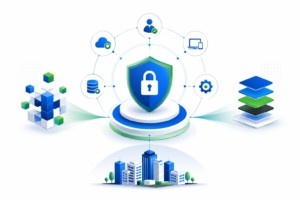
In a hyper-connected global economy, your security is only as strong as the weakest link in your supply chain. Modern enterprises rely on hundreds of third-party vendors—from cloud providers and SaaS platforms to logistics partners and specialized consultants. However, this reliance creates a massive “shadow” attack surface. Adversaries increasingly target smaller, less-secure vendors to gain “backdoor” access into high-value targets. Third-Party Risk Management (TPRM) is the strategic discipline of identifying, assessing, and mitigating the risks introduced by your external partners.
What This Service Means in Modern SOC
Within the VirtualCISO framework, TPRM represents Extended Ecosystem Governance. It is the transition from “Trust by Default” to “Continuous Verification.” In a sophisticated SOC, this service acts as an early warning system. It means moving away from annual, spreadsheet-based surveys that provide only a “snapshot” of a vendor’s security, toward a model of continuous technical monitoring. We ensure that third-party risk is not a siloed procurement activity, but a core component of the organization’s overall cyber resilience strategy.

Key Components / Capabilities
A high-impact cybersecurity strategy is built upon several foundational pillars:
- Vendor Discovery & Tiering: Categorizing every third party based on their access to your data, their connectivity to your network, and their business criticality.
- Automated Technical Scoring: Utilizing specialized tools to gain an outside-in view of a vendor’s security posture (e.g., DNS health, leaked credentials, patching cadence).
- Security Questionnaire Automation: Streamlining the collection of internal security disclosures using standardized frameworks like SIG (Standardized Information Gathering) or CAIQ.
- Contractual Security Requirements: Developing specific "Right to Audit" and "Incident Notification" clauses that hold vendors legally accountable for their security posture.
- Fourth-Party Risk Visibility: Extending oversight to your vendors’ own subcontractors to identify hidden systemic risks in the deep supply chain.
How It Works (Process-Level Explanation)
The TPRM lifecycle follows a structured, five-phase advisory journey:
Phase 1:
Discovery & Contextualization
Discovery & Scoping: Identifying all active third-party relationships and defining the “Vendor Universe.”
Phase 2
Tiered Assessment
Launching appropriate levels of due diligence—high-risk vendors receive deep technical audits, while low-risk vendors undergo basic profiling.
Phase 3
Analysis & Gap Identification
Reviewing vendor disclosures and technical scores to identify “Deal-Breaker” security flaws.
Phase 4
Risk Treatment & Remediatio
Working with the vendor to close identified gaps or implementing internal compensating controls to mitigate the risk of the partnership.
Phase 5
Continuous Monitoring
Utilizing real-time alerts to detect a decline in a vendor’s security score or a breach in their environment before it impacts your organization.
Business Value & Use Cases
Strategic supply chain oversight delivers value that impacts operational stability and legal safety:
Prevention of Backdoor Breaches
Identifying and blocking high-risk connectivity before a vendor’s compromise can traverse into your network.
Regulatory Defensibility
Meeting the supply chain oversight requirements of mandates like NESA, ISR, and the UAE Data Protection Law.
Informed Procurement Decisions
Using objective security data to choose vendors that reduce, rather than increase, the organization’s risk profile.
Resilient Business Continuity
Ensuring that critical service providers have the disaster recovery capabilities required to keep your business running during a crisis.
How to Evaluate Vendors / Solutions
When selecting an advisory partner for TPRM, CISOs should evaluate:
Evidence-Based Assessment
Does the partner rely solely on vendor self-disclosures (which can be biased), or do they utilize objective technical telemetry?
Integration Maturity
Can they help you integrate TPRM data into your advanced SIEM deployment and ITSM tools?
Local & Global Context
Do they understand both global supply chain risks and local UAE regulatory requirements?
Scale & Automation
Can the partner handle a vendor base of hundreds, or is their process manual and slow?
Actionable Remediation
Do they just "find problems," or do they provide a specific roadmap for vendors to improve their security?
Common Challenges & Pitfalls
Questionnaire Fatigue
Overwhelming vendors with thousands of irrelevant questions, leading to inaccurate or “copy-paste” responses.

Stale Assessments:
Relying on a “clean” assessment from 11 months ago to justify a current high-risk integration.
Lack of Fourth-Party Visibility
Failing to realize that your “Secure Vendor” is actually outsourcing critical data processing to a high-risk subcontractor.
Lack of Fourth-Party Visibility
Failing to realize that your “Secure Vendor” is actually outsourcing critical data processing to a high-risk subcontractor.
Maturity Model / Best Practices
01
Level 1 (Reactive)
Vendor security is only checked after a breach occurs; no formal inventory of third parties; high reliance on trust.
02
Level 2 (Repeatable)
Security questionnaires are sent to major vendors annually; manual tracking in spreadsheets; basic “pass/fail” criteria.
03
Level 3 (Proactive)
Vendors are tiered by risk; automated technical scoring is utilized; security requirements are baked into all contracts.
04
Level 4 (Integrated):
Continuous monitoring is active for all critical vendors; TPRM data is integrated into the SOC’s managed detection and response capabilities.
How It Fits Into
Broader SOC Strategy
TPRM is the “Intelligence Feed” for the extended enterprise. It informs the security architecture and design team where to implement extra micro-segmentation for vendor connections and provides the SOC with a watchlist of high-risk external entities to monitor with increased vigilance.
Advisory Note
VirtualCISO acts as your supply chain architect. We do not provide the vendor portal software; instead, we provide the vCISO expertise to design your tiering framework, audit your high-risk partners, and ensure your third-party ecosystem is built on a foundation of verified trust. We turn vendor oversight from a burden into a strategic shield.
We ensure your strategy belongs to you, not your vendors.
Conclusion: The Future of Strategic Defense
The future of TPRM is “Collaborative & Real-Time.” As organizations become more modular, the boundary between “internal” and external will vanish. Organizations that master the transition from point-in-time audits to continuous, automated ecosystem oversight will be the ones that thrive in an increasingly interdependent digital world.