
Fraud and Risk Management
Strategic Overview: Aligning Security with Business Integrity
Fraud and Risk Management is the bridge between technical security controls and executive decision-making. For many, this domain is limited to financial audit checklists. A Virtual CISO perspective elevates this: fraud and risk management must be treated as a strategic business function. The ultimate goal is to move from “checking compliance boxes” to developing a dynamic risk architecture that quantifies potential threats, prioritizes them based on financial and operational impact, and aligns security investments with the organization’s risk appetite.
Comprehensive Risk Exposure Analysis
Organizations that fail to integrate fraud prevention into their broader security strategy are vulnerable to sophisticated threats that bypass traditional defenses. Key exposures include:
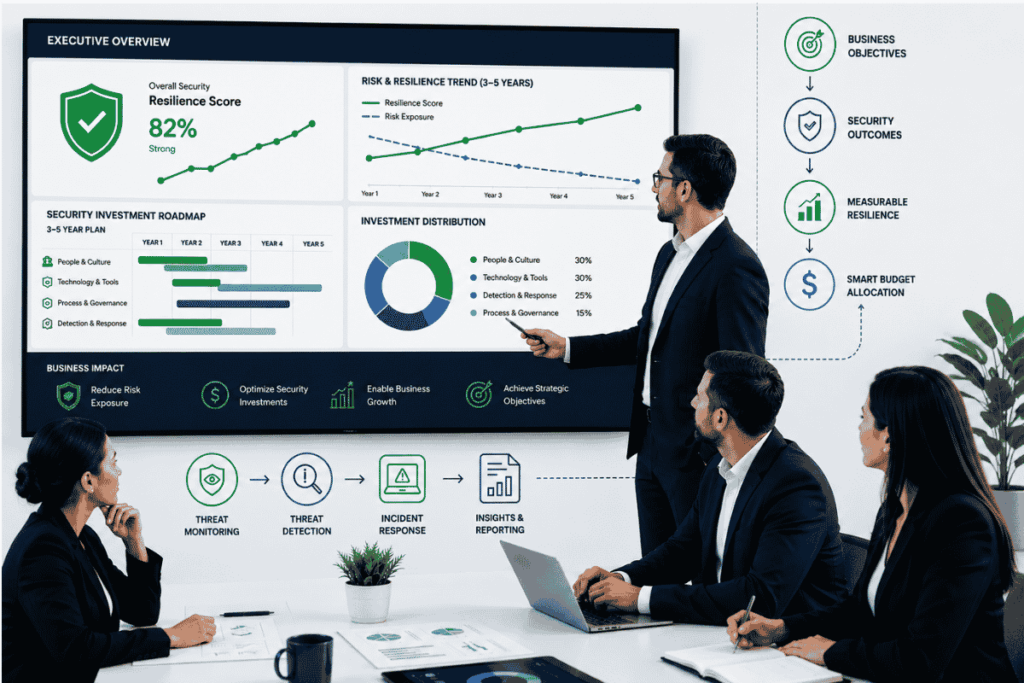
- Business Email Compromise (BEC) and Social Engineering:Attackers often target the human element through sophisticated impersonation of leadership or vendors, leading to significant financial loss that technical controls alone cannot prevent.
- Inadequate Risk Quantification: When risk is managed qualitatively (e.g., "high" vs. "low" impact), it is difficult to justify security investments to the board. Without quantitative data, organizations often overspend on low-risk areas while neglecting critical exposures.
- Supply Chain and Third-Party Risk: An organization is only as resilient as its weakest partner. Third-party vendors with insecure practices serve as backdoors for fraud, data theft, and operational disruption.
- Lack of Integrated Response: When fraud occurs, the response is often siloed. A lack of orchestration between finance, legal, IT, and security teams leads to prolonged response times, worsening the financial and reputational damage.
The Maturity Roadmap and A Progressive Approach
The development of a strategic roadmap follows a rigorous, five-phase advisory lifecycle:
Phase 1:
Discovery & Contextualization
Build a centralized risk register that inventories all known threats—operational, technical, and financial. Establish an initial baseline of inherent risk for all critical business processes.
Phase 2
Quantification & Prioritization
Adopt a structured framework (such as FAIR) to quantify risk in financial terms. This shifts the conversation from technical jargon to business impact, allowing for data-driven prioritization of security
Phase 3
Integrated Governance
Move to continuous risk management. This involves automating the monitoring of key risk indicators (KRIs) and integrating threat intelligence directly into your risk assessment workflows.
Advisory Perspective: Key Questions for Leadership
As a CISO advisor, I encourage leadership to challenge the current state of risk stewardship with these critical questions:
On Quantification
Can we translate our top five cyber risks into potential financial losses, or are we still relying on subjective heatmaps?
On Ownership
Is “risk management” viewed as a security team problem, or is it a shared responsibility across finance, legal, and operational leadership?
On Monitoring
Are we testing our fraud controls (e.g., payment verification, identity validation) through regular, simulated scenarios to ensure they hold up under stress?
Standardized & Key Performance Indicators

Risk Reduction Percentage
The delta between inherent risk and residual risk after security controls are applied.

Mean Time to Remediate (MTTR) High-Risk Findings
The average time taken to close gaps identified in risk assessments.

Third-Party Assessment Coverage:
The percentage of critical vendors that have undergone formal security and fraud risk due diligence.
Conclusion Building Resilience Through Insight
The Cybersecurity Strategy is the “North Star” for the SOC. It defines which threat monitoring and detection services are prioritized and sets the maturity targets for Incident Response. Without a strategy, the SOC is a ship without a rudder—highly functional but moving in no particular direction.