
SECURITY AWARENESS STRATEGY: CULTIVATING A RESILIENT HUMAN FIREWALL
Introduction: The Human Element of the Attack Surface
In an era of multi-billion dollar technical defenses, the human element remains the most targeted vulnerability in the enterprise. Adversaries recognize that it is often easier to trick a distracted employee into clicking a link than it is to bypass a next-generation firewall. Traditional, once-a-year “compliance training” has proven ineffective against sophisticated social engineering and human-operated ransomware. A Security Awareness Strategy is the strategic discipline of utilizing behavioral science to transform your workforce into an active line of defense.
What This Service Means in Modern Context
Within the VirtualCISO framework, Security Awareness Strategy represents Cultural Governance. It is the process of moving from “Tick-Box Training” to “Measurable Behavior Change.” In a modern SOC, this service acts as the preventive layer that reduces the volume of incidents reaching the managed detection and response capabilities. We ensure that security is not viewed as a “Department of No,” but as a shared organizational value, empowering every employee to recognize, report, and resist cyber threats in real-time.

Key Components / Capabilities
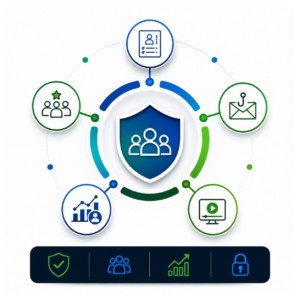
A high-impact cybersecurity strategy is built upon several foundational pillars:
- Role-Based Curriculum Design: Tailoring training content to the specific risks of different departments (e.g., Finance focusing on BEC, Developers focusing on Secure Coding).
- Automated Phishing Simulations: Executing realistic, non-punitive phishing tests to measure susceptibility and provide "just-in-time" training to those who fail.
- Security Champion Programs: Identifying and training influential employees within non-technical departments to act as localized security advocates.
- Behavioral Analytics & Scoring: Utilizing data to track individual and departmental "Risk Scores" based on training completion, simulation performance, and reporting rates.
- Continuous Micro-Learning: Delivering short, high-impact content (3–5 minutes) consistently throughout the year rather than a single, overwhelming annual session.
How It Works (Process-Level Explanation)
The Security Awareness lifecycle follows a structured, five-phase advisory journey:
Phase 1:
Culture & Risk Baselining
Assessing the current “Security Quotient” of the organization through surveys and initial phishing simulations.
Phase 2
Strategy & Content Mapping
Defining the key behavioral goals and selecting the content delivery methods that fit the organizational culture.
Phase 3
Omnichannel Delivery
Launching the curriculum across multiple channels—videos, newsletters, interactive workshops, and physical office cues.
Phase 4
Simulated Stress-Testing:
Regularly testing the workforce with simulations of current real-world TTPs (Tactics, Techniques, and Procedures).
Phase 5
Performance Analytics & Tuning:
Reviewing metrics to identify “High-Risk Groups” and adjusting the strategy to address emerging visibility gaps.
Business Value & Use Cases
Strategic awareness training delivers value that impacts operational resilience and financial stability:
Reduction in Successful Breaches:
Lowering the probability of credential theft and ransomware entry via social engineering.
Improved Incident Reporting Speed
Empowering employees to report suspicious activity early, which drastically reduces the “Dwell Time” of an attacker.
Regulatory & Insurance Alignment
Meeting the mandatory awareness requirements of NESA, ISR, and global standards like ISO 27001.
Cultivating a Positive Security Culture
Reducing the friction between the IT team and the business by fostering mutual understanding and shared responsibility.
How to Evaluate Vendors / Solutions
When selecting an advisory partner or platform for Security Awareness, CISOs should evaluate:
Content Quality & Engagement
Is the training content genuinely engaging, or is it boring "slide-ware" that employees will ignore?
Simulation Sophistication
Does the platform simulate modern threats like QR code phishing (Quishing), Smishing, and Deepfake audio?
Local Language & Culture
For UAE-based entities, is the content available in Arabic and tailored to regional business etiquette?
Integration Depth
Can the awareness data be fed into your SIEM implementation and management to correlate human risk with technical alerts?
Metric Realism
Does the partner provide meaningful analytics (e.g., "Reporting Rate") or just useless "Completion Rates"?
Common Challenges & Pitfalls

The Punitive Trap
Creating a culture of fear where employees are punished for failing simulations, leading to hidden incidents and resentment.

Death by PowerPoint"
Overwhelming employees with long, boring technical sessions that do not lead to actual behavior change.

Lack of Executive Participation
If the C-suite doesn’t take the training, the rest of the organization will view security as unimportant.

Content Stagnation
Using the same phishing templates for years, which fails to prepare employees for evolving adversary techniques.
Maturity Model / Best Practices
01
Level 1 (Compliance-Only)
Training is delivered once a year to satisfy auditors; no simulations; no measurement of behavior.
02
Level 2 (Awareness-Focused)
Regular newsletters and posters are used; some basic phishing simulations; tracking of completion rates.
03
Level 3 (Behavioral):
Role-based curriculum active; frequent, realistic simulations; individual risk scoring is utilized.
04
Level 4 (Cultural):
Security is baked into the organizational DNA; high reporting rates; security champions are active in every department.
How It Fits Into
Broader SOC Strategy
Security Awareness is the “Edge Detection” layer of the SOC. It provides the human telemetry that incident response services rely on for early warnings. An employee reporting a suspicious email is often a faster “sensor” than any technical detection rule, providing a critical head-start during a campaign.
Advisory Note
VirtualCISO acts as your strategic culture architect. We do not provide the training videos; instead, we provide the vCISO expertise to design your strategy, select the engagement platform, and lead the simulations that ensure your people are an asset, not a liability. We help you move from “Compliance” to “Culture.”
We ensure your strategy belongs to you, not your vendors.
Conclusion: The Future of Strategic Defense
The future of security awareness is “Hyper-Personalized & Adaptive.” As AI makes social engineering more convincing, training must become real-time, responding to the specific mistakes an employee makes in their daily workflow. Organizations that invest in a sophisticated, data-driven awareness strategy today will be the ones most capable of surviving the human-centric threats of tomorrow