
COMPLIANCE & REGULATORY ALIGNMENT: TRANSFORMING MANDATES INTO MARKET TRUST
Introduction: The High Cost of Non-Compliance
In today’s regulated digital economy, compliance is no longer a “nice-to-have” checkbox exercise; it is a license to operate. For organizations in the UAE and globally, the regulatory landscape has become a complex matrix of local mandates like NESA, ISR, and UAE IA, alongside international standards like GDPR and PCI-DSS. Failure to align with these requirements results in more than just heavy fines—it leads to reputational damage, loss of operating licenses, and exclusion from high-value government and enterprise contracts. Compliance & Regulatory Alignment is the strategic process of harmonizing your security controls with these legal obligations.
What This Service Means in Modern SOC
Within the VirtualCISO framework, Compliance & Regulatory Alignment represents Continuous Audit Readiness. It is the shift away from the “Compliance Fire Drill”—the frantic scramble for evidence two weeks before an audit. Modern alignment means integrating compliance requirements into the daily workflows of the SOC and IT teams. It is the architectural discipline of “Assess Once, Comply Many,” where a single security control is engineered to satisfy multiple regulatory requirements simultaneously, reducing operational overhead and ensuring a permanent state of defensibility.


Key Components / Capabilities
- Regulatory Mapping & Cross-Walking: Identifying commonalities between different standards (e.g., NIST, ISO 27001, NESA) to eliminate redundant control testing.
- Continuous Control Monitoring (CCM): Utilizing automated tools to verify that security controls are functioning as intended in real-time, rather than at a single point in time.
- Evidence Repository Management: Centralizing the documentation, logs, and screenshots required to prove compliance to internal and external auditors.
- Third-Party Risk Management (TPRM): Extending compliance requirements to your supply chain, ensuring that vendors and partners do not become your weakest link.
- Gap Remediation Planning: A structured approach to identifying where the organization falls short of a mandate and executing the technical or administrative fixes required.
How It Works (Process-Level Explanation)
The Compliance Alignment lifecycle is a structured, five-phase advisory journey:
Phase 1:
Regulatory Discovery:
Phase 2
Baseline Assessment
Phase 3
Control Engineering
Phase 4
Evidence Collection & Automation
Phase 5
Audit Support & Certification
Business Value & Use Cases
Accelerated Market Access
Facilitating faster entry into regulated markets (e.g., Banking, Healthcare, Government) by proving maturity upfront.
Operational Efficiency
Increased Customer Trust
Using certifications as a powerful marketing tool to demonstrate to clients that their data is handled with the highest levels of integrity.
Risk Reduction Transparency
Business Value & Use Cases
When selecting an advisory partner for Compliance & Regulatory Alignment, CISOs should evaluate:
Local UAE Expertise
A concise executive summary of data protection obligations and responsibilities.

Evidence Automation Capability
Do they rely on manual spreadsheets, or can they help you implement security automation and SOAR to collect audit data?
Framework Depth
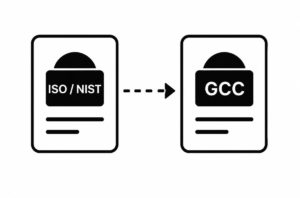
Do they understand the technical nuances of how to map international standards (ISO/NIST) to local GCC mandates?
Agnostic Advisory
Are they trying to sell you a specific "Compliance Software," or are they helping you build a security architecture that is inherently compliant?
Post-Audit Maintenance
Do they walk away after the certificate is issued, or do they provide a roadmap for maintaining compliance year-round?

Common Challenges & Pitfalls
Strategic compliance alignment delivers value that extends far beyond legal safety:
The "Checkbox" Mentality
Treating compliance as a goal in itself rather than a byproduct of a robust security strategy.
Stale Evidence
Collecting data for an audit that is months old, which does not reflect the current risk posture.
Over-Mapping
Siloed Compliance
Maturity Model / Best Practices
01
Level 1 (Reactive):
02
Level 2 (Repeatable):
03
Level 3 (Proactive):
04
Level 4 (Optimized):
How It Fits Into
Broader SOC Strategy
Compliance is the “Assurance Layer” of the SOC. It validates that the threat monitoring and detection services are actually meeting the legal requirements for data protection. It ensures that the SOC isn’t just “detecting threats” but is doing so in a way that is legally defensible and regulator-approved.
Advisory Note
VirtualCISO acts as your strategic compliance navigator. We do not provide the audit certificates; instead, we provide the vCISO expertise to engineer your controls, automate your evidence, and ensure your organization is always “audit-ready.
We turn compliance from a barrier into a strategic asset.
Conclusion: The Future of Continuous Assurance
The future of compliance is “Zero-Touch Audit.” As cloud-native environments become the norm, manual audits will become obsolete, replaced by real-time API-driven validation of controls. Organizations that master the transition to continuous, automated alignment today will be the most trusted and agile players in tomorrow’s digital economy.