RISK MANAGEMENT & GOVERNANCE: MASTERING THE CALCULUS OF UNCERTAINTY
Introduction: From Static Spreadsheets to Strategic Intelligence
In the modern enterprise, risk is not a technical problem to be solved, it is a business reality to be managed. Many organizations fall into the trap of viewing Risk Management as a quarterly checklist a static spreadsheet that collects dust until the next audit. However, in a volatile digital landscape, “risk” is the calculus of uncertainty. Risk Management & Governance is the framework that allows leadership to make informed, data-driven decisions about where to invest, where to accept exposure, and how to protect the organization’s most vital assets.
What This Service Means in Modern Governance
Within the vCISO framework, Risk Management & Governance represents Decision Integrity. It is the process of translating technical vulnerabilities into business impact. Modern governance moves away from subjective “high/medium/low” guesses toward a quantitative and qualitative understanding of risk. It means establishing a common language between the IT department and the Boardroom, ensuring that security policies are not just rules, but guardrails that enable the business to move faster and with greater confidence.
Key Components / Capabilities
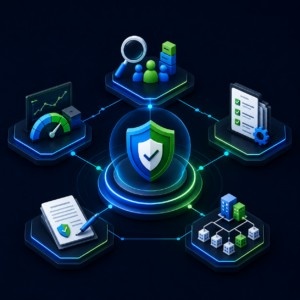
A high-maturity governance capability is built upon five strategic pillars:
- Enterprise Risk Register (ERR): A living document that tracks identified risks, their likelihood, impact, and the status of current mitigation efforts.
- Policy & Procedure Framework Developing a robust set of internal standards (e.g., AUP, Password Policy) aligned with global best practices and local mandates.
- Key Risk Indicators (KRIs): Defining the specific metrics that signal an increase in risk exposure before a breach actually occurs.
- Risk Appetite Statement: A formal document approved by the Board that defines exactly how much risk the organization is willing to take in pursuit of its objectives.
- Governance, Risk, and Compliance (GRC) Automation: Utilizing specialized tools to centralize risk data, automate evidence collection, and provide real-time reporting.
How It Works (Process-Level Explanation)
The Risk Management lifecycle is a continuous loop of discovery and treatment:
Phase 1:
Identification & Taxonomy
Cataloging the technical, operational, and financial risks facing the organization through stakeholder workshops and automated scanning.
Phase 2
Qualitative & Quantitative Analysis:
Assessing the probability of a risk event and the financial/operational cost if it were to occur
Phase 3
Risk Treatment Selection:
Phase 4
Control Implementation:
Engineering the technical or administrative safeguards required to bring the risk within the approved appetite.
Phase 5
Continuous Monitoring & Reporting
Utilizing dashboards to track the effectiveness of controls and reporting residual risk levels to the executive committee.
Business Value & Use Cases
Strategic governance provides a “force multiplier” effect on business performance:
Optimized Resource Allocation
Ensuring that the security budget is spent on the threats that pose the highest actual risk to the business.
Lower Insurance Premiums:
Demonstrating a mature risk posture can significantly reduce the cost of Cyber Liability Insurance.
Enhanced Boardroom Trust
Providing executives with clear, non-technical reports on the health of the organization’s defense.
Operational Resilience
Ensuring that if a risk event occurs, the organization has the predefined governance to respond without internal chaos.
How to Evaluate Vendors / Solutions
When selecting an advisory partner for Risk & Governance, CISOs should evaluate:
Framework Expertise
Does the partner have deep experience in ISO 27005, NIST 800-30, or the FAIR (Factor Analysis of Information Risk) methodology?
Tool Agnosticism
Are they pushing a specific GRC software, or can they help you build a security architecture and design that works with your existing tools?
Business Contextualization
Do they understand the specific risk profile of your industry (e.g., UAE healthcare vs. logistics)?
Actionable Reporting
Do they provide "executive-ready" summaries that highlight residual risk rather than just technical flaws?
Alignment with Local Regs
Is their governance model compliant with local UAE IA, NESA, and ISR standards?
Common Challenges & Pitfalls
The "Compliance is Security" Fallacy
Believing that because you passed an audit, you are low-risk. Compliance is a floor, not a ceiling.
Siloed Risk Management
Managing IT risk in isolation from legal, financial, and operational risks.
Lack of Data Integrity
Basing risk decisions on outdated or incorrect technical data
Over-Complication:
Building a risk framework so complex that business units bypass it to get work done.
Maturity Model / Best Practices
01
Level 1 (Ad-Hoc)
Risk is managed reactively; no formal risk register; policies are outdated or non-existent.
02
Level 2 (Fragmented)
Basic risk registers exist in spreadsheets; policies are in place but rarely enforced or reviewed.
03
Level 3 (Integrated)
Risk management is part of the project lifecycle; GRC tools are utilized; regular reporting to executive leadership.
04
Level 4 (Strategic)
Real-time risk monitoring; quantitative financial risk modeling; risk management is a core part of the organization’s culture.
How It Fits Into
Broader SOC Strategy
Governance is the “Rules of Engagement” for the SOC. It defines which assets are critical enough to warrant managed detection and response capabilities and sets the thresholds for when an event is escalated from an anomaly to a full-scale Incident Response.
Advisory Note
VirtualCISO acts as your independent governance architect. We do not provide the GRC tools themselves; instead, we provide the vCISO expertise to design your framework, audit your controls, and ensure your risk posture is aligned with your business mission. We bridge the gap between technical reality and boardroom expectation.
We ensure your strategy belongs to you, not your vendors.
Conclusion: The Future of Strategic Defense
The future of Risk Management is “Continuous & Automated.” As digital ecosystems expand, point-in-time assessments will be replaced by continuous control monitoring. Organizations that treat governance not as a burden, but as a strategic intelligence function, will be the ones that survive and thrive in an age of constant disruption.